HORSE poker is a popular mixed-game format that challenges players across five poker variants: Texas Hold'em, Omaha Hi/Lo, Razz, Seven Card Stud, and Stud Eight or Better.
In fact, such is the regard for HORSE that it was used for the first annual $50,000 WSOP Poker Players Championship. This prestigious event helped establish HORSE as one of the most skill-testing formats in poker, demanding versatility and a deep knowledge of multiple games. The Poker Players Championship has since evolved to include other mixed game variants, but HORSE is where the tournament started.
We're here to help you saddle up and master HORSE poker rules. Not only that, we'll give you tips on how to play each of its five variants. So, if you're ready, let's gallop through the finer points of this unique poker variant.
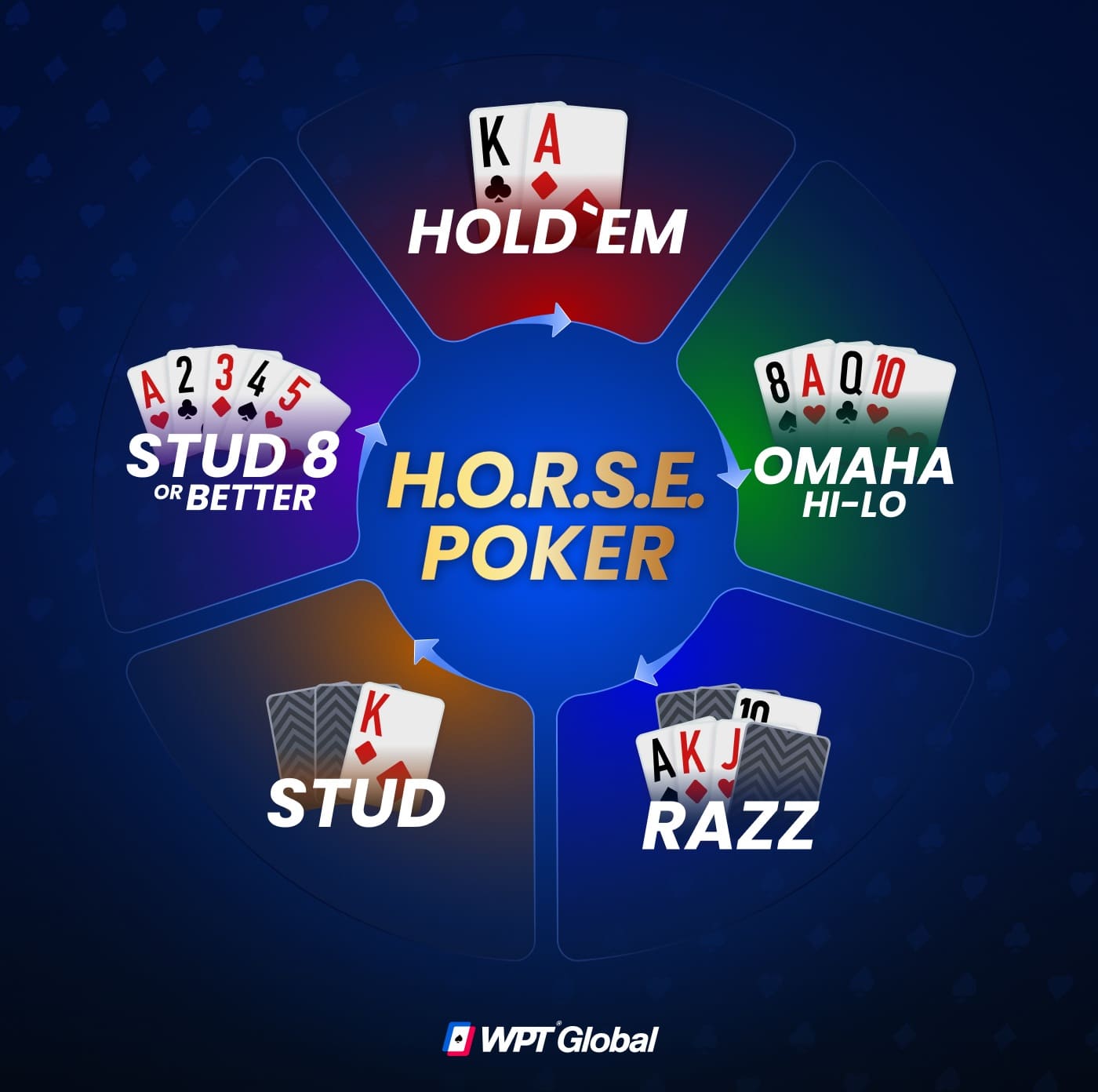
HORSE poker, sometimes written as H.O.R.S.E, is an acronym that stands for five classic poker variants:
Cash games and poker tournaments rotate through these HORSE poker games in the above order (i.e., from Hold'em to Eight or Better) at set intervals. For example, online poker rooms that offer HORSE games might switch the variant every orbit.
The point at which the variant switches doesn't necessarily matter. The key point here is that the variant switches at regular intervals.
That's why HORSE poker rules are seen as a true test of a player's skill.
Not only do you have to learn the rules of different poker games, but you also have to switch between them without skipping a beat. Part of the skill in moving between variants is changing your mindset from flop games to non-flop games.
Hold'em and Omaha are flop games, which means hole cards are combined with community cards. Stud Games, including Razz, don't include community cards.
That means each player receives enough hole cards to make a ranked hand. Switching from flop games to non-flop games is the most important skill in HORSE poker.
This constant shift between board-card and stud formats is exactly why HORSE is considered one of the best poker games to separate the true all-round players from the poker specialists.
To show you how to play HORSE Poker, we'll use an online poker tournament as an example, where the blinds increase every 10 minutes, the variant switches at the end of each level, and we assume you play an average of 10 hands per game.
Then, once the new blind level starts, the game switches to Omaha Hi/Lo for another 10 hands. This dynamic continues until you've cycled through the five different poker games, at which point it returns to Hold'em.
Something new players often struggle with when they're learning how to play HORSE poker is the Fixed Limit betting format. It's not that Fixed Limit is a difficult system to understand; it's that you might not be used to playing certain poker variants this way.
For example, most people play No Limit Texas Hold'em and Pot Limit Omaha. In HORSE, both of these games are Limit. In fact, all games are played with a Fixed Limit format.
You'll also know from our guide playing poker that all variants have forced bets known as blinds and antes. The way in which forced bets are implemented depends on the variant you're playing.
When it comes to forced bets in HORSE, the system changes in line with the variant:
Hold'em and Omaha Hi/Lo = big blind + small blind + button
Razz, Seven Card Stud, and Eight or Better = antes + bring-in
You'll notice that the Stud games don't have a button. To compensate for this, the button doesn't move after the final Omaha Hi/Lo hand. Then, once the game switches back to Hold'em, the button starts moving again in a clockwise direction.
These HORSE poker betting rules remain in place throughout because the order of games never changes.
Remember: the rotation order in HORSE never changes and so mastering each betting format in the sequence is crucial if you want to stay profitable over the long run.
Hand rankings change in line with the poker games you're playing. In most cases, standard high-card rankings apply, which means the best possible hand is a royal flush.
When it comes to Razz and split pot games (i.e. the Hi/Lo games), lowball rankings apply. In Razz poker, the best lowball (aka low-value) hand wins 100% of the pot.
For example, A-2-3-4-7 is called a seven-low because the highest value card is a seven. That hand is worse than A-2-3-4-6 because the highest value card is a six, i.e., it's a six-low.
In a split pot game, the best high-value and lowball win an equal share of the pot. That means the best high-value hand wins 50% of the pot, and the best lowball hand wins 50% of the pot.
Our How to Play Hold'em article should be your first port of call if you're new to this variant. Once you're comfortable with the rules of Texas Hold'em, applying this knowledge to HORSE poker is easy.
The only nuance you need to remember is that it's a Fixed Limit game. If you're used to making big pre-flop bluffs in No Limit Hold'em, you'll need to adjust your strategy in HORSE.
Other than that, the blinds and the button move around the table in the same way. That means you should play tight in early position and gradually widen your range as you get closer to the button.
Omaha Hi/Lo is a split pot game, so high hands and lowball hands win an equal share of the pot. Because of this, the two sets of hand rankings we described earlier are used at all times.
The other important rules you need to know for this betting around are:
You must use exactly two hole cards in conjunction with three community cards to create a high hand. Additionally, you must use exactly two hole cards in conjunction with three community cards to create a lowball hand.
Your highest value card must be eight or lower to qualify for the low portion of the pot. In other words, you can't have a lowball hand if your highest card is a nine or higher. For example, A-3-6-7-8 qualifies as a lowball hand, but A-3-6-7-9 doesn't.
The same player can win the high and low halves of the pot.
If there is no qualifying low hand, the best high hand wins the entire pot.
Check out our guide on How to Play Omaha article for a complete overview of this complex game.
Razz, as we've said, is a lowball game. It's also a Stud variant, which means you receive some cards face down (hole cards) and some face up.
In total, you get seven cards. Two of your first three cards dealt are face down, and one is face-up. After that, the next three cards dealt are face-up. The seventh and final card is dealt face down.
That's the same as Seven Card Stud, as is the fact that everyone posts an ante before any cards are dealt.
The player with the highest value face-up card posts the bring-in. The highest card pays this bet because Razz is a lowball variant, which means low-value cards are best.
Finally, the best lowball hand wins the pot. As we've said, a lowball hand is defined by its high-value card, and straights/flushes don't count against your hand.
The rules for Seven Card Stud poker are almost identical to Razz. If you haven't played before, you can learn how to play Seven Card Stud. Essentially, the cards are dealt in the same way, which means you receive seven cards dealt face up and face down.
The main difference between Stud Hi and Razz is the value of hands. A royal flush is the best possible hand, and high cards are the worst. In line with this, the person required to post the bring-in is the one with the lowest value face-up card.
Stud Hi/Lo combines the rules of Seven Card Stud with Omaha Hi/Lo. By that, we mean the pot is split between the best high and low-value hands. Additionally, you can only qualify for a low-value hand if you don't have any cards over an eight.
If there isn't a qualifying low hand, 100% of the pot goes to the best high-value hand. If there are two or more qualifying low hands, the best one takes 50% of the pot.
The final rule you need to know is quartering. This occurs when two people have the same high or low value hand, meaning that portion of the pot is split.
Here's an example of a quartered pot:
Pot = $100 ($50 goes to the best high hand/$50 goes to the best low hand)
Player 1 wins $50 with the best high hand: A-K-Q-J-10
Player 2 wins $25 (50% of the low pot) with A-3-4-5-7
Player 3 wins $25 (50% of the low pot) with A-3-4-5-7
That's how a pot can be quartered in Stud Eight or Better.
Adaptability is the most important skill you can have in HORSE poker. In many ways, the difference between success and failure in HORSE comes down to who can adapt the quickest.
That's because the mindset you need to win hands in Hold'em and Omaha is different from Stud games. Therefore, if you can learn to flow from one game to another, you're already ahead of the curve when it comes to HORSE poker strategy.
Of course, that's easier said than done. Moving between variants requires an understanding of basic strategy concepts in poker, such as positional advantage, hand reading, opening ranges, and bet sizing.
You can get an overview of these concepts by checking out our poker cheat sheet. Once you've mastered those concepts, you can add these skills to your repertoire:
Virtually all poker players know how to play Hold'em, so you can assume there will be fewer soft spots during this betting round. Some experienced poker players are fairly well versed in Seven Card Stud, but the average skill level drops off quickly after that.
Therefore, if you can master basic strategy in Omaha Hi/Lo, Razz, and Stud Eight or Better, you're more likely to get an edge in HORSE cash games and tournaments.
We can only talk in general terms here because every situation is different. However, when it comes to opening hand ranges, you should adopt a tight mentality when you're playing Razz, Seven Card Stud, and Stud Eight or Better.
When you're playing Hold'em and Omaha Hi/Lo, be slightly looser. That doesn't mean you can play any hand from any position. However, because Hold'em and Omaha have community cards, there's more scope to be creative and bluff.
Bankroll management is important as a general concept in poker. However, you can also apply the same mindset to HORSE poker games.
Basically, it's not a good idea to play big pots with weak hands in HORSE. We're not saying you can't bluff, but the reality is that you shouldn't do it very often.
The simple reason you need to be more disciplined is that you're playing Fixed Limit poker. That makes it harder to put pressure on opponents, which, in turn, makes it less likely they'll fold when they've got a decent hand.
Therefore, you should be more conservative with your bets. Learn to value bet when you feel like you're winning, and control the pot when you might be behind. Get this right, and you'll be a much stronger player.
Another strong tip is to try to study professional HORSE tournaments such as the WSOP Poker Players Championship, where mixed-game specialists showcase optimal strategies in real time.
To practice this skill, as well as everything else we've discussed, it's a good idea to play HORSE poker online for free. If you can't find any freerolls, use play-money tables to get comfortable with HORSE before moving to real-money games.






 Customer Dispute Resolution Page
 Help Center
 Affiliate Program